
Presence, Precision & the Power of Reclaiming the Room
- shelley8051
- Jul 4, 2025
- 3 min read

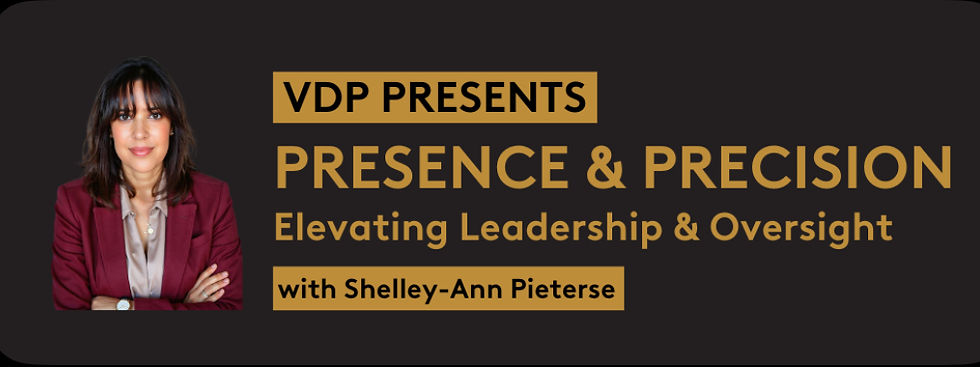
This week I stepped onto the Veblen stage (virtually) to facilitate a session called:
“Presence & Precision: Elevating Leadership & Oversight.”
It was my first time coaching in that space.
And honestly? I was excited.
No nerves, no drama. Just a quiet confidence that I was ready and that I had something valuable to offer.
Did a whisper of the old perfectionist pop up?
Of course.
It tried to tell me I’d forgotten something, or that I could probably squeeze in three more contingency slides.
But I’d already done the real prep:
I’d thought deeply about what would resonate, what would challenge, and how to create a space that felt both safe and stretching.
So I let the inner overachiever have a seat and focused on the people in the room.
The feedback afterwards reaffirmed what I hoped:
It helped.
It landed.
It made people think differently.
And for me, that’s the win.
Presence as Recovery
Presence used to mean performance.
Anticipating ten steps ahead.
Pre-emptively defending against questions that hadn’t even been asked.
I would physically be in the room, but mentally I was already halfway through a Q&A that hadn’t started yet. Not surprisingly, this created anxiety, disconnection, and sleepless nights before anything big.
Now, presence means being anchored in the now.
It’s choosing to stay with what’s actually happening, rather than predicting where it might go.
I still prep - thoroughly - but once I’m in the room, I’m there.
With the people.
Listening.
Responding.
Trusting myself to handle whatever comes.
And yes, I have a secret weapon:
I dance.
Not metaphorically. Literally.
Specifically, I do the Wobble.
My fur child was initially baffled, but has now come to accept the pre-session ritual and wisely steers clear of the floor.
There’s something about choreography that helps my brain stop spiralling. It gets me back in my body. It calms the noise. It says: we’ve got this - and we probably look pretty good doing it (or so I tell myself - furchild's judgy eyes hints at something different).
Precision Without Perfectionism
Perfectionism used to show up as control.
I’d try to cover every possible question, angle, or scenario - you know, just in case.
There’s a version of me that would have still been reworking slides at midnight before the session, telling herself that if she could just predict every outcome, she’d be safe.
But here’s the thing:
You don’t need to be perfect to be powerful.
Coaching taught me that.
What matters is presence, energy, and authenticity.
And the biggest shift? Realising that the answers I need are already within me.
Now, precision isn’t about controlling every detail.
It’s about choosing where to place my energy.
It’s about clarity. Intentionality. Trust.
Instead of exhausting myself trying to meet every external expectation, I focus on showing up in the rooms that matter - to me - and doing it in a way that feels real.
Visibility on My Terms
I used to be scared to speak up in certain rooms, especially ones where no one looked like me.
I’d second-guess myself, wondering if I’d sound naive or worse, weak.
Now? I’ve stopped giving so much airtime to that internal critic.
Because I’ve realised something simple but transformative:
What other people think of me matters less than how I feel about myself.
I’m more comfortable with being seen now, because I’ve done the work to see myself first.
And because I choose the rooms I show up in, I’m not performing. I’m contributing.
Visibility isn’t exposure anymore. It’s alignment.
So Why Share This?
Because if you’re a high-performing woman reading this, there’s a good chance you’ve experienced the same tangle I have:
The overthinking masked as preparation
The perfectionism dressed up as professionalism
The fear of visibility disguised as humility
Here’s what I want you to know:
Presence can be reclaimed.
Precision can be redefined.
Visibility can feel safe.
And it starts by trusting that the person you are now is more than enough.
Even if she dances alone before big meetings.


Comments